Showing posts with label comment. Show all posts

7.08.2010

Johannes Mehserle

Thoughts and prayers to the people of Oakland.

Tonight is the first night in a long time that I remembered to be grateful I live in a suburb. Working in downtown SF, I let my staff go home as soon as we heard the Mehserle verdict, the rest of the building seemed to follow. At 6 is was unusually empty and quiet. There was concern about rioting and violence. In SF, things were calm. Twitter feeds at 7 began with news of calm gatherings, at 9, the news on Twitter and KCBS was of bottles and police in riot gear. At 9.30, winding our way home on Hwy. 24, we saw a ribbon of flashing blue and red lights, we stopped counting at 12, but think we saw 50, maybe 60, police reinforcements, complete with vans, trucks, red firefighter trucks and white paramedic vans. A bizarre, unnerving spectacle on the nighttime freeway.

My heart goes out to the residents of Oakland. A riot and violence like this is tragic - so much loss. In the news, as we arrived home, the stories began to come in of protesters hurt, a young woman's injury to the eye, stones, bottles, tear gas.

Join me to express solidarity with the residents of Oakland, hope for their safety, and soonest return to peace.

6.07.2010

Why Should People Buy and Own Art?

by Alan Bamberger:

Selling art can be just as hard, if not harder, than making art. This sentiment has been and will continue to be echoed by fine artists everywhere for as long as artists make art. The instant a work of art is finished and ready to leave an artist's studio, that artist is now confronted with the seemingly insurmountable task of having to convince someone somewhere that not only is the art worth experiencing, enjoying and appreciating, but also that it will provide a lifetime of gratification and-- perish the thought-- that it's even worth buying and owning. So in the interest of minimizing the pain and suffering of selling your art-- and of encouraging more people everywhere to own more art-- please feel free to incorporate any or all of the following helpful hints about why art is worth owning into as many of your sales presentations as necessary:

* Art is a powerful form of expression not only for the artists who create it, but also for those who own it. Art allows people to express their individuality, and to represent deeply held beliefs, feelings, convictions or philosophies in socially (and visually) redeeming ways.

* Art encourages people to ask questions, to take brief moments out of our busy lives to reflect on ideas other than how to make more money faster or how to get over on the competition.

* Art improves quality of life. All you have to do is think about the difference between a room with bare walls and one with walls full of art.

* Art inspires people to think about and even visualize ways that life might one day be better than it is now.

* Art stimulates the expression and interchange of thoughts, feelings, and ideas among total strangers who might never otherwise say a single word to each other.

* Children are fascinated with art. Art makes children ask questions, encourages them to fantasize and imagine, and expends their perceptions of reality. Art teaches children how to be creative and have fun with life.

* Art transforms and personalizes the places where we live and work. Art can evolve lifeless interiors-- homes as well as offices-- into unique, beautiful and engaging environments.

* For those so inclined, art can be used to signify wealth, success or power, and can even be used to intimidate. For example, imagine a CEO's office appointed with a big bold, vibrant, dynamic painting hanging on the wall directly behind his desk, and two imposing larger-than-life sculptures, one at either side of the desk. Anyone who sits and meets with this individual must also contend with his art.

* An original work of art is not only visually appealing, but it also communicates the personality, abilities, creativity, inspiration, attitudes, and at best, the brilliance and genius of the artist who created it. And people who own art are able to experience and be uplifted by these qualities on an ongoing basis.

* An original work of art reflects, enhances and even magnifies the personality of the individual who owns it.

* Art attracts attention on global as well as personal levels. An impressive or extensive personal art collection can be likened in microcosm to that of a great museum, and certainly increases the esteem of that individual among his or her peers. In fact, many of the great personal art collections end up in museums.

* Art makes people proud to live, work, and play where they do. They point to their museums, public monuments, and cultural institutions with pride.

For those of you buyers who like to profit from your art, people decide where to spend their time (and money) based on the types or amounts of art they know or expect to encounter. For example, commercial spaces such as restaurants, hotels, and meeting places can be more or less interesting and attractive to patrons depending on the art they have on display (or lack of it).

* Art is environmentally friendly, energy efficient, and easy to maintain. It does not increase global warming, use fossil fuels, or need to be serviced on a regular basis, and it's certainly not just another expendable destined for the landfill.

* Across the country and around the world, artists move into troubled or blighted neighborhoods or parts of cities and revitalize them with their artistry. Their creative expression increases property values, new businesses move in, and the overall quality of life improves immeasurably. Sooner or later, the public at large discovers these wondrous transformations, and in some cases, people actually travel thousands of miles to visit these oases, spend time there, and of course, buy art.

That's right. Owning original art has numerous benefits. Perhaps it's not quite so hard to sell after all.

2.16.2010

Thai Bui: Spark | KQED Public Media for Northern CA


"I think that represents two nature forces, negative and positive, and also it can be yin and yang, and it may be black and white, and also become united."-- Thai Bui


  • Vietnamese-born sculptor Thai Bui makes haunting works of art that speak to a sense of displacement and longing that has characterized the artist's own turbulent life. Bui's extraordinary objects combine references to his experiences in both the United States and Vietnam, simultaneously communicating a witty humor and penetrating sense of loss. In "Looking East," Spark visits with Bui as he installs a major public commission for the city of Palo Alto.

Growing up in Hanoi during the Vietnam War, Bui's childhood was marked by uncertainty and terror. In 1981, at the age of 21, Bui emigrated to the United States to study art. The transition was difficult for the artist, who has had to deal with language and cultural barriers. In addition, as a northerner, Bui often feels like an outsider within the Vietnamese community in the Bay Area, which is largely composed of southern Vietnamese.

Much of Bui's work deals with these experiences, making reference to childhood games as well as feelings of displacement. Spark visits the artist in his studio as he makes a series of shallow clay bowls. While they are still wet, Bui slams the bowls onto the floor, blowing a hole in the base of the pots and making a loud sound. The activity references a simple childhood game in which the participant that makes the loudest sound wins. Bui then gathers the remnants and incorporates them into an installation.

For more please click on the following link: Thai Bui, Spark profile

Thai Bui's work is on exhibition through February 28.

1.10.2010

Connections, Culture and Collections:


On Jan 8, I was invited to speak before the Bay Area Glass Institute (BAGI to friends) about beginning an art collection and how to supplement an existing one. It was a fun evening for me, with a warm and welcoming audience. Here is an excerpt from the BAGI blog about the event:

On Friday night there was a buzz at the Community School of Music and Art. Nearly 100 people came to enjoy wine, appetizers, conversation and a talk by Micaela Van Zwoll. Collectors, artists and students spent the hour before the talk in the lobby with art-related discussions ranging from how they became interested in art to what they are working on now. (Click here to see photos from the event.)

The audience moved into the auditorium just after 7:00 and were greeted by a slide show highlighting Bay Area art collections that include glass sculpture as well a range of artists that Micaela choose to highlight. There were many artists, ranging from emerging to mid-career to established, and collections included in the talk. I was excited to see images of works from the
Saxe Collection and the Hess Collection as well as Stig Persson, a wonderfully clean thinking Danish artist; San Francisco Bay Area pioneer Marvin Lipofsky (who was shown by Micaela at SCOPE Art Show at Art Basel, Miami Beach); educators and artists Susan Longini and Carol Lawton (who were also in the audience).

An insightful observation that Micaela made about buying art was that all of us have collected something (in her case it started with Matchbox cars many years ago) and that we should use that same sense of wonder and excitement when deciding what art to collect. Another takeaway from Micaela was that the difference between an established artist and all others on the path to becoming an established is the ability for a piece to be sold in the secondary market. Why is that important? Because it means there is enough understanding and representation of an artist to be able to set a price for a work in the open market.

The evening wrapped up shortly after 8:00 with an appeal to attend the BAGI Great Glass Auction on February 6th.

Thank you, BAGI, for a fun evening!

11.10.2009

Douglass Freed

Finding a Market for Large-Scale Art, by Ligaya Figueras

Lumiere
A series of five 64” x 42” paintings by Brad Benson hang in a public space at
Pinnacle Entertainment’s Lumière Place Casino & Hotels in St. Louis.
Photo by Kathleen Clark.

The recent downturn has resulted in less private buyers placing gigantic 2D pieces in palatial homes. “The market for large scale is not what it previously was,” states Carolyn Miles, the owner of Atrium Gallery in St. Louis, which specializes in large-scale artwork.

For artists working in bigger formats, the current economic climate means the market for large-scale artwork is limited.

“Few people have the wall-space and eye-space (the ability to move far enough back in the space to see the painting properly) to acquire them,” states Lauren Rabb, owner and director of The Gallery at 6th & 6th in Tucson, Arizona.

To meet these new challenges, artists who work in a larger scale should consider corporate settings as another market for their creations. Larger pieces grace lofty entrance lobbies and other gathering spaces at convention centers, restaurants and casinos. Banks, office buildings, condominium lobbies and upscale hotels are also privately owned properties with massive public spaces in need of adornment.

“They present an opportunity for elegance and scale,” comments Miles.

Acclaimed landscape painter
Douglass Freed of Sedalia, Missouri has always produced large-scale works. His paintings are in the collections of numerous corporations, including Sprint, Hewlett Packard, Pella, McGraw-Hill, Maytag, Blue Cross/Blue Shield of Missouri and banks throughout the Midwest. In fact, most of his sales these days are corporate commissions.

“Corporations are the patrons of our time,” says
Freed, who in 2008 completed a massive 108 x 320 in. river landscape for the Emerson Electric Corporation headquarters in St. Louis, and Epoch, a 96 x 120 in. painting that hangs in the new Federal Reserve Bank of Kansas City.

Make Me a Match

Rise
Rise/Set by Doug Freed hangs in the Emerson Electric headquarters in St.
Louis, Missouri. The oil on canvas painting is 108 x 320 in.
“Hotels don’t hire artists. Architects and designers do,” states Evelyn Daniel-Putnam, President of Daniel Fine Art Services in Laguna Beach, California. “Design firms create a path for people like me.” Her company is a preeminent art-consulting firm for luxury hotel and casinos, managing projects worldwide for clients such as Hilton, Ritz-Carlton and Hyatt.

“We make decisions about theme, budget, direction. Art consultants are not supposed to be pushing inventory. We are a research team,” explains Daniel-Putnam.

Pinnacle Entertainment, which owns and operates gaming entertainment facilities throughout the U.S, works exclusively with Daniel Fine Art Services to choose artwork for its properties, such as the recently completed $507 million Lumière Place entertainment complex in St. Louis and a $67 million expansion of the L’Auberge du Lac Casino Resort in Lake Charles, Louisiana.

“The art has to capture the style of the property and blend with the design,” states Pam Gates, Pinnacle’s manager of procurement for design and construction. “The L’Auberge du Lac Casino Resort has a Texas Hill Country lodge theme, so we were looking for local Louisiana art.”

According to Freed, private institutions and companies are attracted by the composition of his pieces.
The artist states, “Though I am a landscape painter, I’m truly an abstract artist. My artwork draws you in; it is accessible because the paintings are about time and light. … Meditative paintings work well in big, modern, contemporary concrete spaces, and I have the ability to do large, monumental paintings whereas most landscape painters are easel painters.”

Freed also keeps the titles of his works ambiguous and universal. For example, he titled the Emerson piece Rise/Set to imply an early morning or late evening. “Everyone has had the experience of a lake or ocean in early morning or night,” he says.

Getting a Foot in the Lobby

Art consultants need to find artwork for their clients quickly and efficiently. To reduce the amount of legwork required, they tend to go to trusted sources.

“When I am looking for artwork, I visit galleries and studios, go online, and talk with people in the art community.” states art consultant Mary McElwain, owner of McElwain Fine Arts who also served as the art advisor to the Federal Reserve Bank of Kansas City on the commission awarded to Doug Freed. Art advisors tend to work through galleries, so artists who have gallery representation have an advantage against artists who attempt to work independently with art consultants. Freed’s Federal Reserve Bank project, for instance, was handled through Sherry Leedy Contemporary Art Gallery in Kansas City, one of a dozen galleries across the U.S. that shows his paintings.The Web is another channel that enables artists and art consultants to get connected. “It’s all Internet,” says Daniels-Putnam, whose company finds artists from all over the world via the World Wide Web. “It used to be slide registry. Now it’s ‘look at the artist’s Web site.’”

One major artist list that interior designers and art consultants review is ArtistRegistry.com. The site is administered by Western States Arts Federation (WESTAF), a non-profit regional arts service organization dedicated to the creative advancement and preservation of the arts in western states, although any artist who is a U.S. resident can showcase his or her art on the site.

Besides making it easy for consultants and buyers to discover them on the Web, artists can seek out those who make purchasing decisions for corporate facilities. McElwain suggests that artists find out which architecture and design firms in their area specialize in large spaces and that they send a targeted mailing to the head of the design department at these firms. The American Institute of Architects Web site (
www.AIA.org ) posts a directory of AIA members in every city.

Marketing materials can also be sent to art consultants, some of who, like McElwain, are members of the International Association for Professional Art Advisors. The organization provides guidelines and standards for professional art advisors and serves as a network for communication among art advisors, curators and art service professionals. Members are listed on the IAPAA Web site (
www.IAPAA.org ). Another helpful resource for developing a targeted mailing list is the “Corporate Art Market” section of the Artist Help Network Web site (www.ArtistHelpNetwork.com ).
Contributing writer and communications consultant Ligaya Figueras specializes in business writing, marketing and media relations for visual and performance artists, writers, nonprofit organizations and specialty service providers. She can be reached at
figuerasl@sbcglobal.net .

Copyright 2009 Ligaya Figueras. First published by Art Calendar magazine (www.artcalendar.com), the business magazine for visual artists. Used with permission.


11.03.2009

Quebec blog features Marie-Lou Desmeules!

Yesterday morning, a blog item from Pat White, a writer from Quebec, popped up in our emails! It's fabuloso to see press about our artists - and it takes things to a different level to see our new exhibition, Winter Salon 2009, written up in French! L'artiste québécoise Marilou Desmeules expose à San Francisco au Winter Salon 2009 | PatWhite.com. You don't read French? Many of us don't, but Marie-Lou's native language is French, so I'll post this for her as I found it. Briefly, Mr. White states, "Marie-Lou Desmeules, originally from Quebec, currently residing in Berlin, is an artist delighted with the extraordinary."

The attached image, featured in the Winter Salon 2009: "In Gold We Trust," is from her latest series, "Too Much is Not Enough." Performance, painting, photograph C-Print on Fuji paper, 119 x 84 cm.

Marie-Lou recently participated in an exhibition in Milan. More on that at another time.

6.08.2009

Another one bites the dust, a requiem to San Francisco art galleries

For a while, the economic realities facing the world have been blamed for the decline of the contemporary art market. A surprising outcome of the decline is newfound collaborations among galleries and a fresh willingness from galleries for price transparency. In some cases, the downturn brought misfortune to San Francisco with multiple losses of one fine art gallery after another. Some say this is a natural expectation, and an opportunity for the best to rise resulting from attrition, but the list is surprising. It includes prominent art dealers who have the diminished and seriously downsized their exhibition spaces, or have closed their doors and are lost to the gallery world ether. In alpha, not chron order, some of them are:

ArtWorksSF – Contemporary fine art, mixed media, photograph and performance space moved out of 49 Geary digs to 2861 California Street from which they manage a roster of local café exhibitions as well a portraiture business.

Bucheon – Always edgy and avant garde, the two ladies who ran the scene from the obscure upper Hayes Street in late 1990s, to hip lower Hayes in early 2000s, and final posh space on Grove Street last, are gone. It’s quiet where they were, as their last exhibition announced narrative works by artists Eckhard Etzold, Michael Frerris Jr., Mars-1, Sarah Ratchye, Gordon Henderson, Lordan Bunch, Laurel Connell, Olive Ayhens, Danny Keith, Alex Luke, Megan Wolfe, David Choong Lee, Lucho Pozo, Dan Nicoletta and Christina Empedocles, in a large show for such a small space. The show was extended, and some gallery alumnae have been redistributed, and welcomed with alacrity, by Mark Wolfe Contemporary Art, for example.

Cain SchulteCain Schulte Gallery – With a consistently critical schedule of exhibitions, the gallery that morphed in 2006 out of Michael Martin’s space on Townsend and 3d Street by it’s two partners, Marina Cain and Kit Schulte, has moved to 714 Guerrero Street. Continuing to support its artists and clients with a full schedule of privately run home-based exhibitions and events, Cain Schulte representing contemporary artists from the United States and Europe with a focus in painting, the gallery promises to consistently participate in national and international art fairs. The word is that Kit’s established a gallery in Berlin, as Marina continues the business privately while seeking better digs. Go, Cain Schulte! You give galleries a good name.

Don SokerDon Soker Contemporary Art bode farewell to the 49 Geary community with a small reception hosted by Claire Carlevaro of Art Exchange Gallery this March. A beloved gentleman gallerist, the word is that he’s gone to private consulting while his website states an upcoming inaugural exhibition at an immense new space somewhere in the heart of San Francisco’s financial district. A standout presenter with a good eye for solid relevant artworks, this will be something to look forward to.

Oakland’s Esteban Sabar closed his gallery last August, another casualty. Just two years after its opening, and one year after its initial foray into Art Miami|Basel scene, the gallery is gone. The initial controversy generaged by the new rush of 20 something hipsters that 'invaded' and discovered Oakland’s downtown overnight wasn’t enough to support an established ‘art scene.’ Its owner, Esteban Sabar, earned respect with disarming charm and the sort of unabashed honesty one rarely encounters regularly in the art world, whatever corner of it you find yourself in. Flamboyant, garrulous, friendly, and possessed with unique talents, Sabar is silent these days. I hope it won’t be for long as his program was so far out it was fun and refreshing.

Gallery 415’s focus on Latin American artists moved out of its 49 Geary home to the heart of the Mission District. While this seems apropos given the large Hispanic community that considers the Mission its home, the rest of us are probably envious of the unique opportunity to present from the growing importance of the newest group of artists: the San Francisco Mission School. While the gallery’s owner, Claudine intends to focus on private art consulting at her new location, it’s probable that she will continue to champion artwork by emerging and mid career Latin American artists, in step with the recent focus on Latin America, as well as the growth of affluence and desire to invest by the American-born Hispanic community. Luckily, growth in Latin American art, artists and collectors, is not just a blip on the radar anymore, as Art Basel at Miami has certainly made things much more accessible! New address: 622 - 27th Street, San Francisco.

Hacket-Freedman, another Hayes Valley alum, closed its doors as of May 1. Founded in 1986, by Michael Hackett and Tracy Freedman, the gallery offered a select inventory of 20th-century and contemporary painting and sculpture, with a particular focus on postwar American and Californian art; the established partnership specialized in represented contemporary realism, including the estate of David Park. One partner is off to the wilds of private consulting, while the other will manage the rest of the collection, I’ve heard.

Hang Art introduced a novel approach to buying art in the late 1990s with its clear and published business structure. Using a happy formula for emerging artists with non-wavering price formulas that are client-friendly too (their website states they show artwork under $200!). The gallery showcases works by emerging artists and features a list of ‘staff picks’ and actively promotes affordable artworks to a broad collector base. On May 1, Hang Art downsized to one exhibition space at 567 Sutter Street. Smart move.

Octavia’s Haze – Sometime in 2008, painter James Michalopoulos began to show his work exclusively at the space developed by Michael Melampy. The cleverly-named gallery showed glass objects and vessels on the corner of, ahem, Octavia and Hayes Streets from about 1999 to 2008. Now co-mingled on lower Hayes Street with another shop, and while the name doesn’t seem as apt or clever as it was at its old space, they seem to be continue a brisk trade in hand blown glass vessels with their new partners.

Reaves Gallery – Sharon Reaves, artist mentor turned art dealer, took her emerging artist business from the Castro to a beautiful space on Gough Street. A year later (actually just a week or so ago) and according to its website, the gallery is gone for rebranding, and its website now features the Reaves Collection. Sharon tells me she’s gone for the opportunity of a lifetime in NYC. Lifetime opportunities are good. Loud applause.

871 Fine Arts – Fine art book, posters, artists books and other ephemera moved out of 49 Geary next to Crown Point Press on Hawthorne Lane. Quiet move, not much fanfare, in fact hardly any, as former clients still come by looking for it.

Weinstein Gallery – This powerhouse gallery showing modern works by Chagall, Miro, and Picasso, as well as uber-pricey glass sculptures by Christopher Reis, closed its Grant Street space to consolidate with its posh mega space on the corner of Powell and Geary Streets last week.

Wow. That’s quite a list. Oh, I forgot, there’s another casualty - what about the quiet-made-quite-public-furor over the tenured staff slash and burn at SF’s venerable San Francisco Art Institute... in the name of the economy, etc. Oh well, so much for San Francisco’s fame as an art vanguard.Micaela Gallery

We San Franciscans are fortunate to still have a couple of galleries left, and hope to benefit from a couple of surprising moves. Altman|Siegel’s directors came west as they grew out of gallery experiences in NYC and moved in to 49 Geary, Jack Fischer moved out of his exciting mini gallery into Don Soker’s window-lit space and is rockin’ San Francisco. Micaela moved her glass sculpture and media arts out of Hayes Valley (and hopes the move was not jinxed by the Hayes Valley kiss of death) and into ArtWorkSF’s space, also at 49 Geary, and painter-turned-gallerist George Lawson opened up Room for Painting Room for Paper next door to Micaela.

For those that are gone, we hope it’s farewell but not goodbye. For those that reduced their efforts and await the economy to rebound, and for the rest of us, long live contemporary fine art in San Francisco!

3.17.2009

Jack Hanley Gallery, San Francisco

The Jack Hanley Gallery’s reputation for fine art is formed by its consistent representation of avant-garde artists, including some who were instrumental in forming what has become known as the San Francisco Mission School of art. Jack Hanley owns another gallery in Tribeca, New York, but the earlier gallery is located in the heart of San Francisco’s Mission District (395 Valencia Street, to be exact). Labeled a superstar owner, Hanley, was described in a 2007 interview by Brian Andrews (for badatsports.com), as a gallerist who ‘runs with the big dogs.’ An exotic figure, Hanley is a handsome, large man possessing a wholly dramatic appearance that includes an enviously full head of long flowing white locks (tamed with a scunchi band at this year’s Armory Show).

read more | digg story

3.15.2009

San Francisco art critic, Alan Bamberger

It's difficult to write about art critics...because one just doesn't want to 'kiss up' or pander to the critics, knowing that a critic can sway an observing public with a few words this way or that.

read more | digg story

1.20.2009

Culture

Today, the culture of America has a new face. It is young, hopeful and energetic. It is the face of your neighbor, of the kids in your kids' schools, of immigrants, of your colleague at work, of the new chairman of the board. It is the face of Barack Obama and everything he represents - change, hope, and progress.

Welcome to America. Welcome, Obama.

image by Shepard Fairey

10.10.2008

Good-bye, Hayes Valley! Hello, 49 Geary!


Dear Reader,

It's official...we're moving to 49 Geary.

We're very, very sad to leave our Hayes Valley home of 12 years, but we're (kind of, sort of) grown-up, and it's time to move away. Our new home is at 49 Geary, Suite 234, where we look forward to welcoming you to our Winter Salon 2008, opening November 15.

If you're on our emailing list, you'll have received our announcement, about the move and our moving sale (if you're not on our list, please sign up!). Yes, we're having a moving sale - from now through October 25, everything is reduced by 10%. It's the only time we have ever done a sale, and the only time we plan to have a sale. The sale is only for works currently available, from our current and previous exhibitions, and does not apply to works previously sold. The discount does not reflect any reduced artwork value and is solely for the purpose of reducing our relocation inventory.
We hope you appreciate it for what it is - an opportunity to acquire some pretty fabulous artwork at a really good price. Why are we doing a sale? The truth is (yes, we've been known to be uncommonly truthful) that we'd prefer to place them instead of waiting until we re-open at our new home to show them. And yes, we're incredibly busy packing up and getting ready for our move, our exhibition at SOFA Chicago, the Winter Salon (opens Nov. 15), and Bridge Art Fair, Miami Beach...whew, it's exhausting!

9.10.2008

For those of us that think glass sculpture is new...

Okay, I understand you could make a seriously good argument for design/decorative work here, not a true glass sculpture...This link is to an article published in Reuters, discussing the ewer, pictured at right, carved rock crystal, from the late 10th or early 11th century, as seen in this undated handout photo made available by Christie's in London on September 10, 2008. The 1,000-year-old ewer, one of only seven known surviving examples, will be offered for auction next month at Christie's Islamic art sale and is expected to fetch over 3 million pounds ($5.3 million). REUTERS/Christie's/Handout (BRITAIN)

8.16.2008

Commute, Comments + Contact

Dear Reader,

First, thank you for reading this blog. Really. It's very good to know you're here.

Today's post is something of a rant (please forgive me, the need is overwhelming). I commute to work from the East Bay to San Francisco. Most of my friends think I'm nuts to do it, but the truth is that I love the cultural aspects of San Francisco too much to settle for a comfortable life in the 'burbs. Occasionally, it's an awesome commute. Like today. Saturday, traffic backed up for miles in the Maze, impossible to get on the Bay Bridge because...a cute little red VW flower child car rear-ended a cheap white Toyota driven by dread-locked flower children (the Toyota was a total loss, rear end crumpled into oblivion, VW seemingly unscathed). When I finally zoomed by and craned my neck to get a good look, all parties (a gazillion young people) were not at all peacefully coming to terms with this event of their young lives. No one looked hurt, I am grateful for the driving God that graced them with that blessing, and hurtled on to work...and here is what I found... You know, this can't be what my realtor meant when he told me this was a high traffic area...bloodcurdling WHINEZZZ from the three (yup, the third mixer is in front of the other two) cement mixers, bone-jarring DRILLLLINGGGGG, GRINNNNDDDDINGGG stuff from the jackhammers...oh, yeah, today's going to be a great day for business. Spare yourself, just stay away.

Next, to all you lovely (I mean it, lovely) artists who like this blog and the stuff I'm posting about you - please, please say so in the "comments" section of this blog. It's there for you. You'll either make my day or break it, but certainly someone else will be happy to read it. People love to hear from artists, especially when the work is supported by a gallery and promoted as fiercely as we promote you! If you're shy and don't want to post your own comments regarding this blog, have no fear - I will. It's only right that people know what you have to say. Don't worry, I'll give you full credit for your comments, I'll be polite and nice, and promise never to credit anything you say to myself. On the other hand, if you have something just for my tender ears (yes, they are...and they get more so over the growing years), be assured - I do read all the email you send to me. I reply with amazing speed to compliments, but it takes an eternity to recover from emails even mildly laced with acid or strychnine. How to contact me? Email is best - micaela@micaela.com. I spend 'way too much time on the phone and work like a fiend to promote your work and pay my bills, so telephone calls and personal visits are strongly discouraged. But if you're determined to ignore that little personal thought, give it a try at:

Micaela Gallery
333 Hayes Street, San Francisco, CA 94102 USA
tel. 415.551.8118
(you have my website url, that's how you got here, right?)

Cheers to you for now, and hasta manana, my friend.

Ever truly yours,
Micaela

8.06.2008

More on the Chihuly exhibitio at the De Young, comments by Kenneth Baker, etc...

Kenneth Baker's article is fun to read - so are his rebuttals and inspirations to the fore! Read on: from Regina at the Seattle Post Intellingencer; from Mr. Baker himself; and from other vanguards of glass sculpture, such as The Oregonian. From moderates to high minded culturati, let's discuss! Bravo Dale Chihuly! Bravo Kenneth Baker!

8.04.2008

Dale Chihuly at the de Young

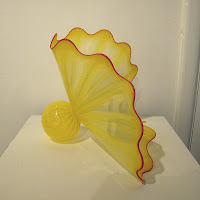
Dale Chilhuly's work is at de Young Museum in San Francisco. I'm starting this blog w/ some thoughts about the exhibition because so many people who visited our COLD+HOT 2008 exhibition asked me about Dale Chihuly's work and Kenneth Baker's notes on Chihuly in his San Francisco Chronicle review.
I love the drama of Chihuly's installation at the de Young! Who doesn't? It's larger than life and vibrant. Chihuly's choices of color and reflective surfaces appropriately serve to emphasize his work, mesmerize, allow for sculptural presence, respect the viewer, and grant opportunities to view the work from multiple angles. But is it fine art or decoration, I’m continuously asked, after all Mr. Baker is a well-respected supporter of the San Francisco art community (and I might get lumped in with the "admirers of empty virtuosity" crowd here...). My impulse is to defend Chihuly as a fine artist and draw comparisons of fine art vis-à-vis decorative art, but curators and museums in homage to design and decorative arts in New York, Los Angeles, Paris are better able than I to outline and blurr definitive concepts of the disciplines to very narrow, very particular details. So the question is more whether or not anyone cares that the Chihuly exhibition is one of fine art or decorative art. Does anyone? If our ideas of classic fine art developed from primitive attempts to communicate events, to develop iconographies and patronize ideologies, if fine art encompasses realms of artworks based on exchanges of ideas, what is fine art about Chihuly’s work? Well, what isn’t? As with previous installations, his decision to show artwork on an outré scale dwarfs all concept of glass sculpture, obliges us to revisit our knowledge of glass and its place in culture. The visual drama of Chihuly’s work by its cacophony of color and unheard of scale carries visual weight similar to Donald Judd’s minimalism and strict adherence to linear form. Judd presented sculptures that forced the viewer to ask, “What is this?” Likewise, Chihuly’s work takes the viewer’s personal history of every glass vessel and decorative object into play and ask the same question: "What is this?" We are presented with blown glass sculptures that occupy space, present the viewer with a visual spectable, demonstrate technical mastery of the medium, and challenge us to accept his work in the narrowly defined world of fine art.
I do not own any work by Dale Chihuly because it’s not part of my particular aesthetic yet, but you can probably tell by reading this that I do love glass sculpture. I love sculpture in general, from Calder and Giacometti to Kapoor, Libenski and Rodin. Chihuly’s work possesses a sensational aspect that arouses suspicion from my very formal nature, while the visual part of me loves the nouveau approach to art that is wholly satisfied by the exhibition at the de Young (after all, isn't part of the attraction of art its novelty?) and its sensory assault. Baker's critique reminds me of IM Pei's diadem at the Louvre and all the hoo-ha questions about whether it was appropriate for such a venerable institution, likewise with Gehry’s beautiful museum in Bilbao. For glass sculptors, Chihuly’s exhibition is validating. It redefines fine art tradition with its occupation of space and light, and challenges old-world techniques by its
response to ever-growing cries for “bigger!” and “more!” By nature, glass is one of the most difficult sculptural mediums to sculpt. The artist is made to choose whether to work with it cold, with a chisel or other carving tool, or to heat it up to over 2000°F and form its shape by blowing - and subject the medium to the sculptor’s skill, remaining sensational in all aspects of its manipulation. The fantastic aspects of glass - it’s liquid nature and relationship to light - keep it at the fore of wonderment. Its material plasticity allow it to take on whatever shape commanded by its sculptor, and the developing culture amongst glass sculptors and collectors, private and public art institutions, that is warmly cohesive, full of camaraderie, and supported by considerable sums of serious money, clearly proclaims glass is a fine art medium whose time is now, no longer the ignominious little sibling of sculpture.
Thanks to Chihuly, the American studio glass movement moved out of the craft shop to generously publicly funded institutions and enjoys international support. We no longer dismiss the glass object as a crafty little knick-knack, our ideas of decoration and design are enriched by a sculptural medium that has been around for millennia, and recently brought out of the dusty annals of history to join the high voltage fine art techniques of the 21st century. Thanks to Mr. Baker, we have an ongoing dialogue of the place of glass sculpture in the fine art world. Such is the draw of popular notoriety and of art that blossoms from humble beginnings to international buzz.